September 2021
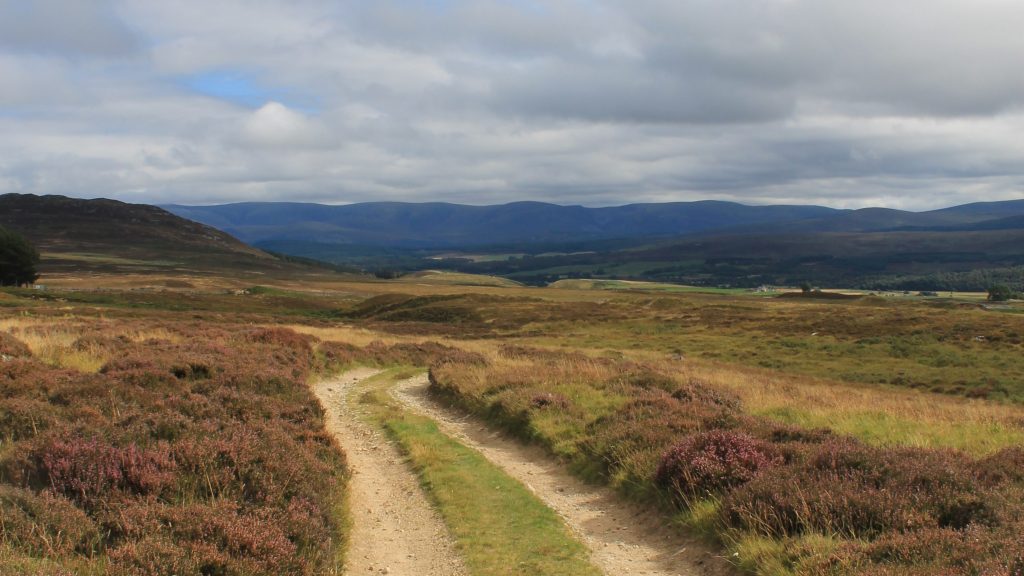
Strone lies just behind Newtonmore: a few houses and crofts along a road that rises from the village, curves round and descends back into it, between the main road and the moor. I’ve been here for a late summer holiday. The rowans, ancient protectors of Highland homes, are ripe with berries, but I was surprised to be greeted by swallows not yet embarked upon their journey south. On the way up from the train, I met five little piggies who were beyond excited by my wheelie case and rang after me up the whole length of their enclosure. The fields are full of sheep and cows, horses and ponies, and a white mule who from a distance looks like a horse — until it opens its mouth. I don’t think I’ve ever met a mule before, but I’m quite taken with this one.
Rooks and jackdaws share the fields with the livestock, as well as pied wagtails, finches (including a flock of goldfinches), wood pigeons, and pheasants: a few nights ago, I spotted one of those in an ungrazed field and was amazed at how it just sank out of view when it saw me. On the moor, there are the inevitable meadow pipits. Today, I disturbed what I think was a sandpiper, which made a change from disturbing juvenile pheasants. And I was alerted — by the corvids who were escorting it off the premises — by what was presumably a red kite, given the shape of its tail.
When I went online to check about kites in the area, my search engine’s matches told me a different story than the one I wanted to hear. One of them, from only last year, concerned news that a red kite found killed had been confirmed as one of the first to have fledged in Strathspey and Badenoch since the late nineteenth century. I suppose I had foolishly presumed that raptor persecution didn’t happen in Cairngorm National Park; and no charges were brought, etc. Clearly, however, there are some round these parts for whom the humans who shoot birds are preferable as tourists to those of us who follow birds with awe instead.
On the gates to the moorland, signs warn that stalking and shooting sometimes take place on these hills. A paragraph explains why management of red deer is necessary, given the lack of non-human predators. It’s interesting, however, that apart from a cover-all mention of the funds that hunting and shooting brings in, there is no comparable attempt to justify grouse-shooting. Perhaps it’s thought that we have more affinity with the splendour of deer than with gamebirds. Or perhaps it’s because there is little justification for grouse-shooting other than cash, and certainly none that can be claimed on behalf of the natural environment given how it has been extensively altered to enable the sport in the first place. I can’t help thinking there must be other ways to pay for the management of these hills and moors, one based on symbiosis rather than exploitation.
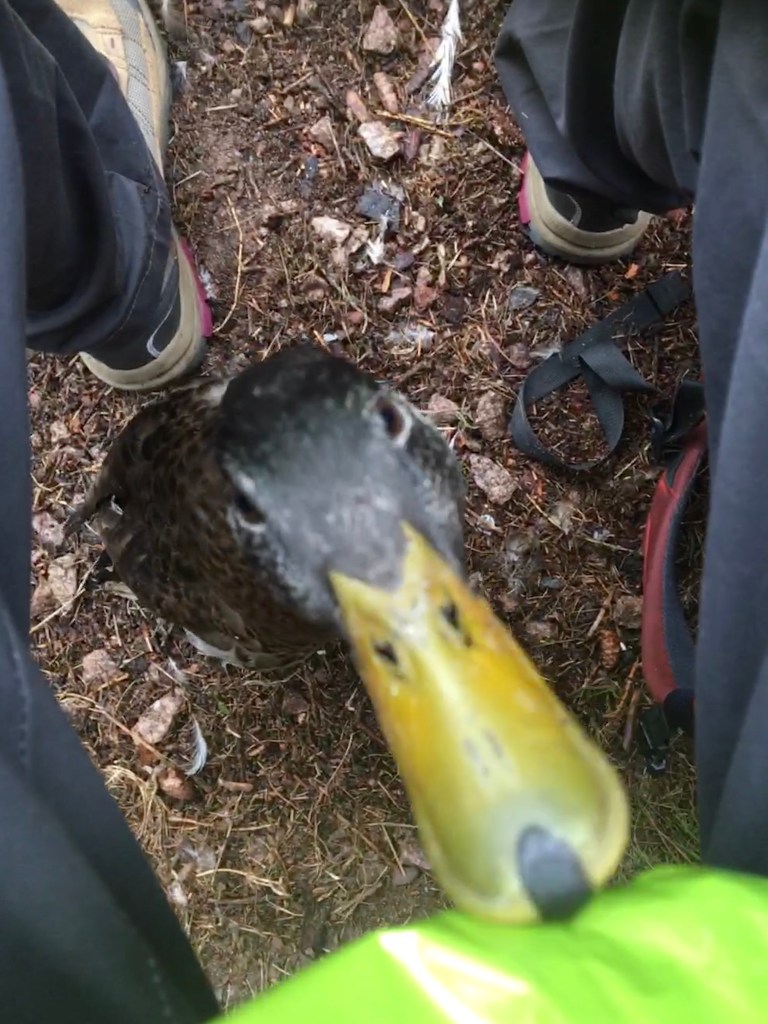
Wildlife exploit us too, of course. Earlier in the week, I went to Loch Imrich in the centre of Newtonmore for a short walk, and was accosted and assailed from all sides by a very large, and very precocious, and very noisy batch of mallards. Most seemed to be young birds moulting into their adult plumage, all seemed to be Very Hungry. They looked at me as if I was stupid. I’m sorry, I said, I didn’t know I was meant to bring food.
I returned there today, with several slices left from this week’s loaf. I wouldn’t normally feed birds bread, but this stuff was at least enriched with oats and seeds; and I’d seen that the Wildcat Experience Centre down the road sold duck food, so I was confident that these ducks do get access to more nutritious food on a regular basis. Plus, there were just so many of them, at so small a loch — really a large pond — that I felt I could justify shoving a few empty calories their way that otherwise would have gone in the bin.
I reckon there must have been at least fifty ducks. A couple — one in particular — had learned the “stick by the human and act cute” trick, to which I of course succumbed. I managed to leave with all fingers intact, and was very impressed by how quickly the ducks clicked that the food bag was finally empty. They lost interest then. But it’s only what we deserve.
 Cultures of Peace