Berlin, 2016
This year I shared my balcony with a sparrow named Chirp. (I have no idea what his real, sparrow name is, but since he always announced himself with “chirp”, which seems to be sparrow for “I am here”, it seemed to fit).
Chirps’s nest was under the roof of my building, a little bit across from my balcony. He would often sit at the corner of my balcony announcing his territory — and it was his territory, mostly, his and his partner’s. (She did not simply chirp, but had a very long, fast, cheeri-cheeri-cheeri as if she was constantly nagging him.)
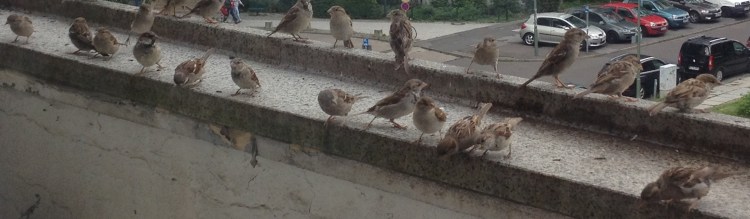
I often put food out for the birds, and had always had quite a few sparrows; but when nesting began, the number dwindled: mostly just Chirp and his nagging other half, and occasionally two female sparrows who for all I know may have been a couple. (Some types of bird can be gay: apparently, around a quarter of male black swans are gay, and they sometimes kidnap cygnets from other black swans and raise them as their own.)
Now I’m no expert at identifying sparrows, or at least, telling them apart. Chirp was pretty skinny, but I never did find a distinguishing feature. So I knew him by his behaviour; and he, eventually, knew me.
I wasn’t sure whether any of the birds had figured out where the birdseed came from. (I didn’t have a feeder, so I just spread some on the balcony wall.) Whenever I went on to the balcony they would fly away, but at some point, I thought, they will make the connection between the big mammal appearing and the seed appearing. In fact, as I later realised, Chirp often watched from the roof, and eventually he figured out that the seed came from me, and that it tended to appear after he’d been on the balcony, chirping. So then, he started asking for it.
Chirp must have been able to see me through the window when he was at the corner of the balcony and I was sitting at the kitchen table. And sometimes, when there was no seed out, he would actually look in the window towards me — rather than facing outwards, when communicating with other birds — and chirp: “I am here!” (Subtweet: “Can I have some seed, please?”) So I would go through to the balcony door in the other room, and look out through the glass; he would then come hopping down the balcony towards me, and make a show of looking round to see if there was any birdseed. When I opened the door, he would fly back down to the far end of the balcony, and when I crossed the threshold he would fly off, returning a few minutes later, mostly, for the seed I had left. Sometimes, it was only a few seconds. I sometimes thought he would look in through the glass balcony door while eating it, so he knew I knew he’d found it, but I may be overinterpreting.
But Chirp was not the only visitor to my balcony. There was also Pidge.
Pidge is a wood pigeon – a female, I reckon, though it’s difficult to tell with wood pigeons. Sometimes courted, but mostly alone, she would quickly hoover up any seed she could find. Sparrows need to unhusk all but the smallest seeds before they can swallow them; wood pigeons take most of them whole, and because they are so much bigger and faster (and have internal storage for food they will digest later), there was rarely any left for Chirp after Pidge had been. But I love wood pigeons, and I felt sorry for Pidge because the trees in my street where the wood pigeons liked to sit disappeared one-by-one over the years, leaving them only lampposts and roofs — and my balcony. So I didn’t mind her at all.
I did, however, take exception to her stealing the food that Chirp had specifically and so politely asked for. It seemed bad bird manners. Pidge very often sat on the balcony for long periods watching the world go by, as wood pigeons do, but it was a bit much when she sat right next to, or even on, the birdseed she hadn’t finished eating yet,
One day, Chirp asked for some seed and was given some. About an hour or so later, he was back at the window, looking into the kitchen at me, chirping again. I was pretty surprised at this because it normally took him a good few hours to get through the seed. Surely you don’t need more already? “Chirp! Chirp! Chirp!!!”
So I went through to the balcony — and there was Pidge, polishing off the seed. Poor Chirp.
I spent a lot of the next few hours chasing Pidge away from the balcony, repeatedly. Sometimes she went no further than the roof above, even though I gave her the evil eye. And she kept coming back, mostly not landing more than a few seconds before I spotted her. (It’s difficult to be stealthy when you’re a wood pigeon. You’re too big, and your wings make too much noise when you fly). Eventually she got the message and stayed away. Shortly after, Chirp returned.
I think it was the next day or the day after that I walked into the room leading on to the balcony, and Pidge was sitting in on the balcony table, looking in through the door, opening and shutting her beak. She’d never done that before, but it was a definite “Food?” sign. She’d learned the trick — and was given some seed. In fact, I put out two piles, and a wee while later Chirp, Pidge, and some other sparrows happily sat together on the balcony, pecking away.
Pidge never asked again, but I never chased her away again, either.
By this point, however, things were changing. Occasionally, another sparrow – also a male — would be at Chirp’s spot on the balcony. He was fatter than Chirp, and a tiny bit more fluffy around the edges. I reckon he was Chirp’s son from that year’s first brood, copying Dad and defending territory while Dad catered to the second brood. Chirp Junior didn’t have his Dad’s trust in the big mammal, however, and tended to fly off when he saw me.
He got seed anyway.
 Cultures of Peace